Form builder 2 | Base version
The Form Builder makes it child's play to create complex forms with independent task areas. It has a modular structure and can be used flexibly for any cases.
Purchase the Plugin
This plugin can be purchased in the Shopware Community Store.
Important note: You need the free moori Foundation plugin.
Custom forms for Shopware 6
- You want to create your own forms in Shopware?
- You don't have a Shopware Professional subscription, but don't want to do without this essential feature?
- The possibilities of the Shopware Professional form builder are not enough?
- You build complex forms and are looking for a good basis for your individual adjustments?
If you can answer one of these questions with "yes", then you are definitely on the right track!
Example forms for download
Further examples can be found in the respective documentation of the add-ons!
Add-Ons
This plugin has been shortened in its basic version by some functions, so that it can be offered at an affordable price. affordable price. All further functions can be obtained.
The complete feature overview covers the base plugin and all add-ons. Each plugin directory contains a CODEX.md documenting its extension contracts and limits.
- Classic Add-On: Conditions, repeaters, additional fields, submission history, printing and additional actions
- Exit-Intent-Popups Add-On: Use forms as popup
- Slides Add-On: Use slides
- Customer-Forms Add-On: Customised forms for registration and customer area
- Product-Configurator Add-On: Additional information on products incl. price calculation
- Order Add-On: Additional checkout inputs, optional checkout lock and storage on the order
- Product-Request Add-On: Product-specific enquiry forms
- CSV Add-On: Write mapped form inputs to CSV files
- Hubspot Add-On: Send data using a configured HubSpot integration
- Mautic Add-On: Mautic form/contact integration
- Webhook Add-On: Configurable HTTP requests with form data
- Custom add-ons on request
(* In development, ** In concept phase)
Example Add-On for developers
Example Add-On. Its local version contains outdated method signatures and must be adapted to the current base interfaces before activation. See its CODEX.md and the feature overview.
What is this plugin good for?
The Shopware 6 Form Builder 2 plugin makes it child's play to create complex forms with independent task areas.
It is modular, so processes and individual fields can be expanded as desired.
Installation
Note
If you have any problems with the plugin, please note the following notes in the FAQ section.
- install Foundation
- install Form Builder 2 in the Plugin Manager
- go to: Contents | Form Builder 2
Here you can create or import a new form.
Settings
The screenshots in this guide show the English administration in Full HD (1920 × 1080). Both documentation languages use the same images.
Basic configuration
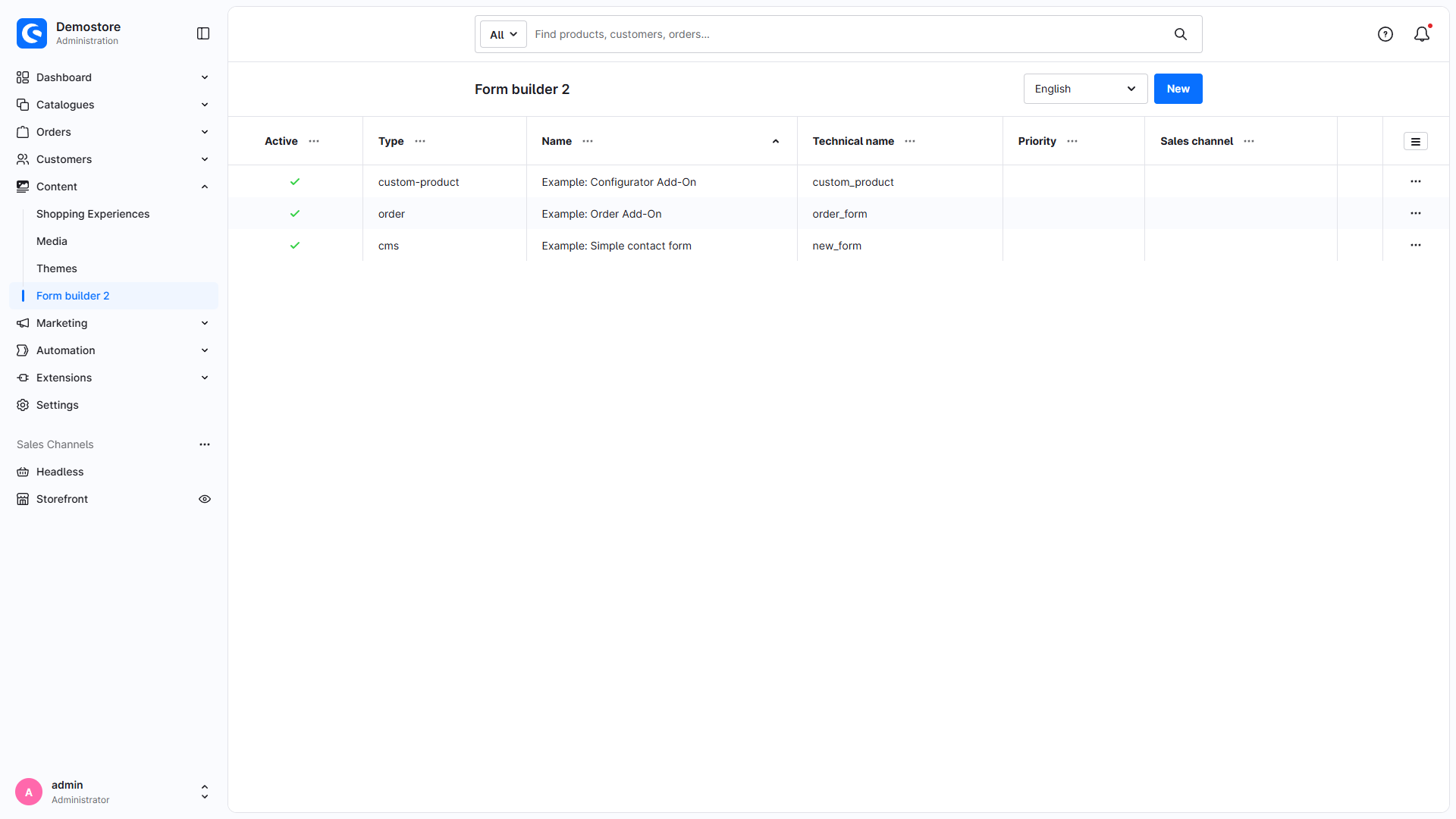
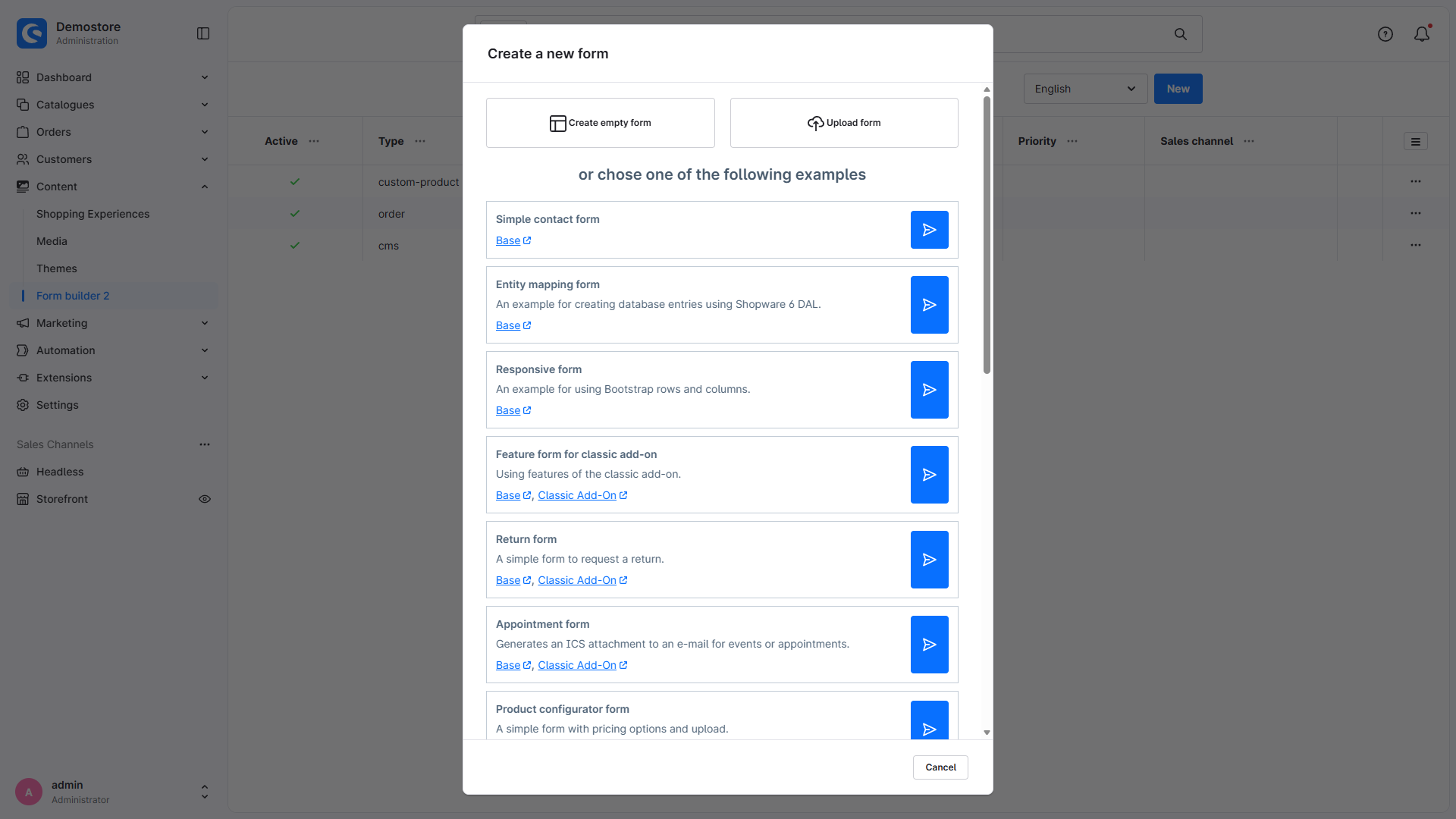
- create new form
- import
- form settings
- save form
- export
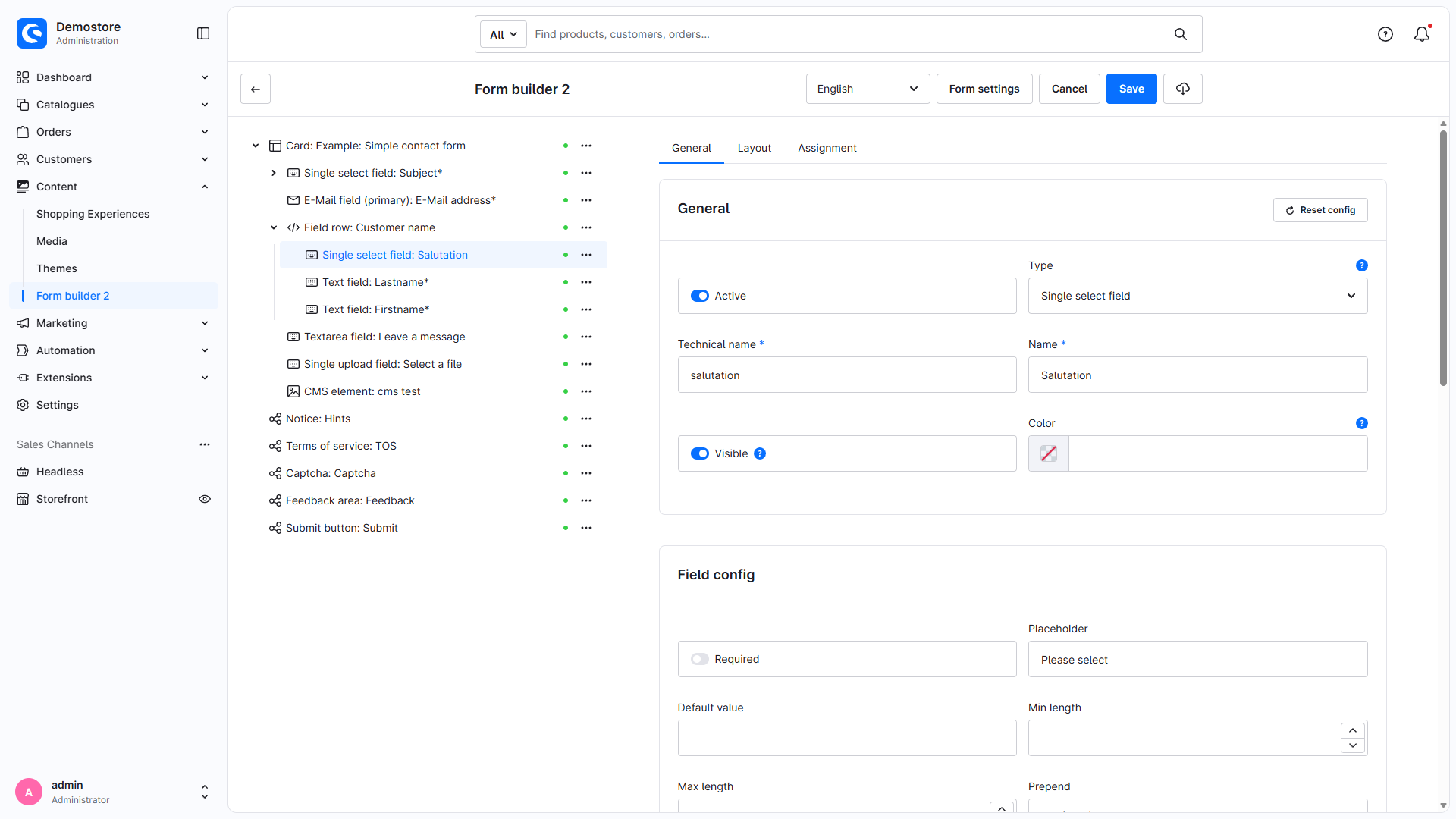
- structure area of the form elements
- settings area (form/element)
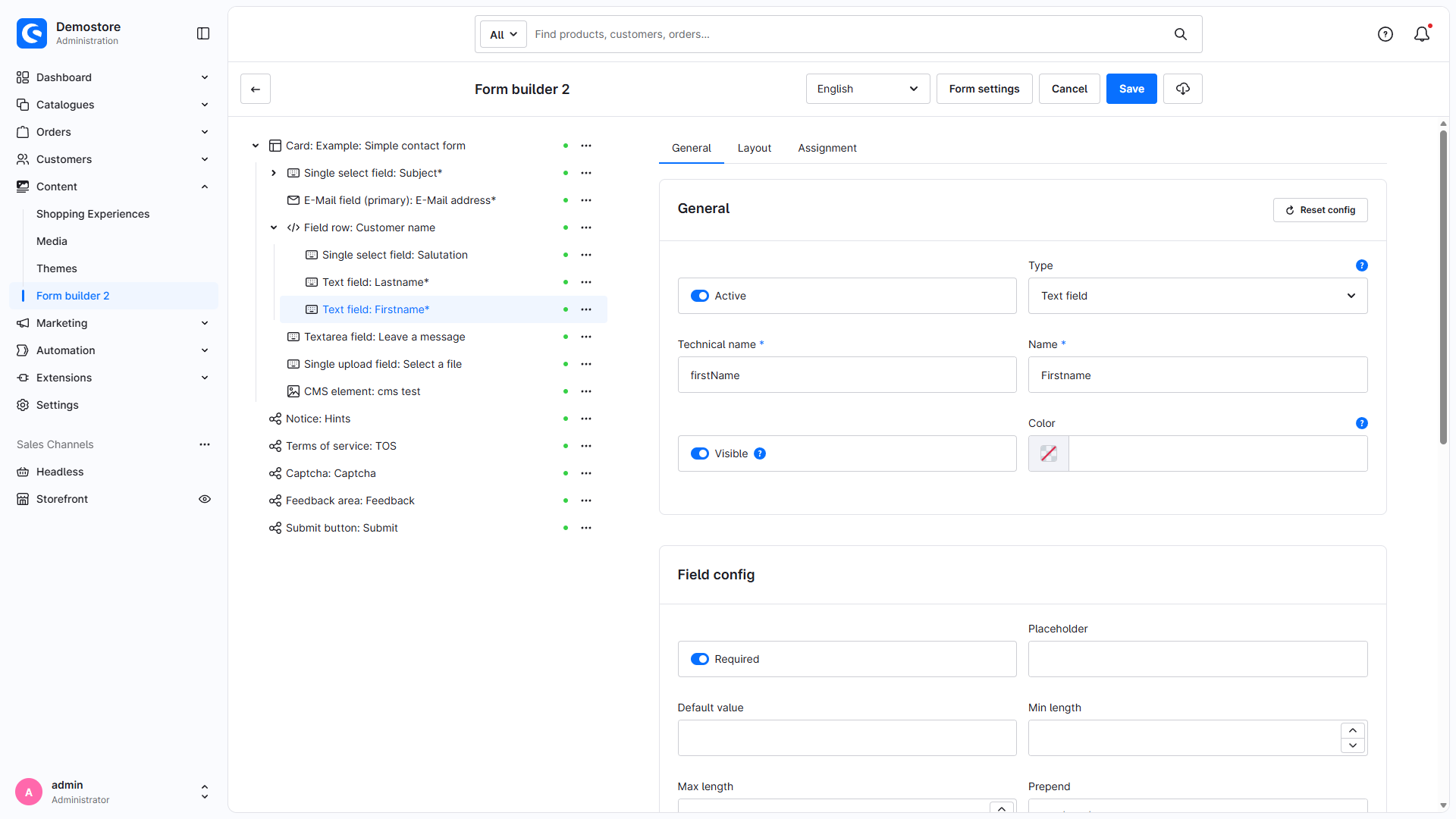
- context menu for creating, deleting or duplicating elements
- general element settings
Settings in detail
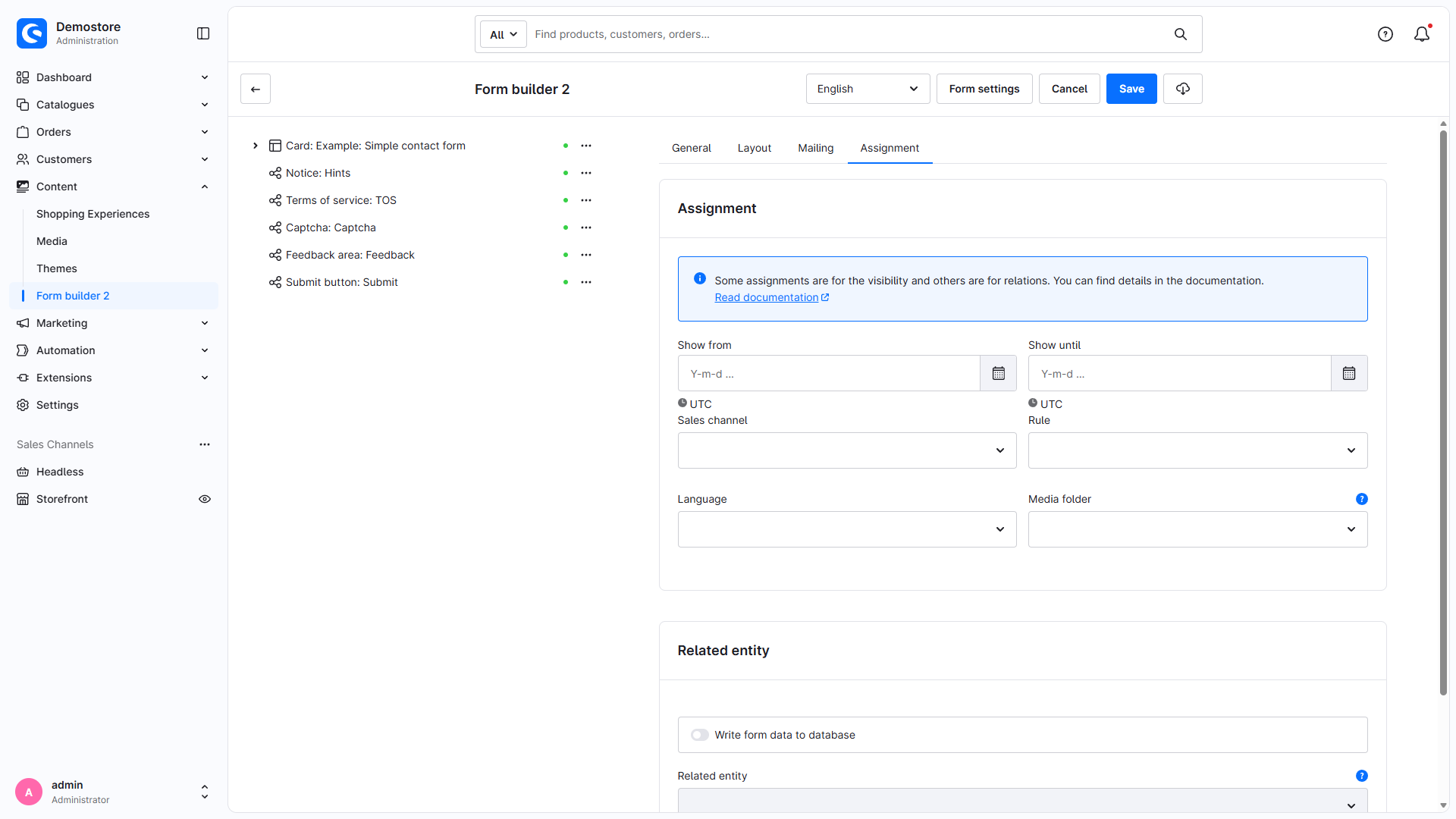
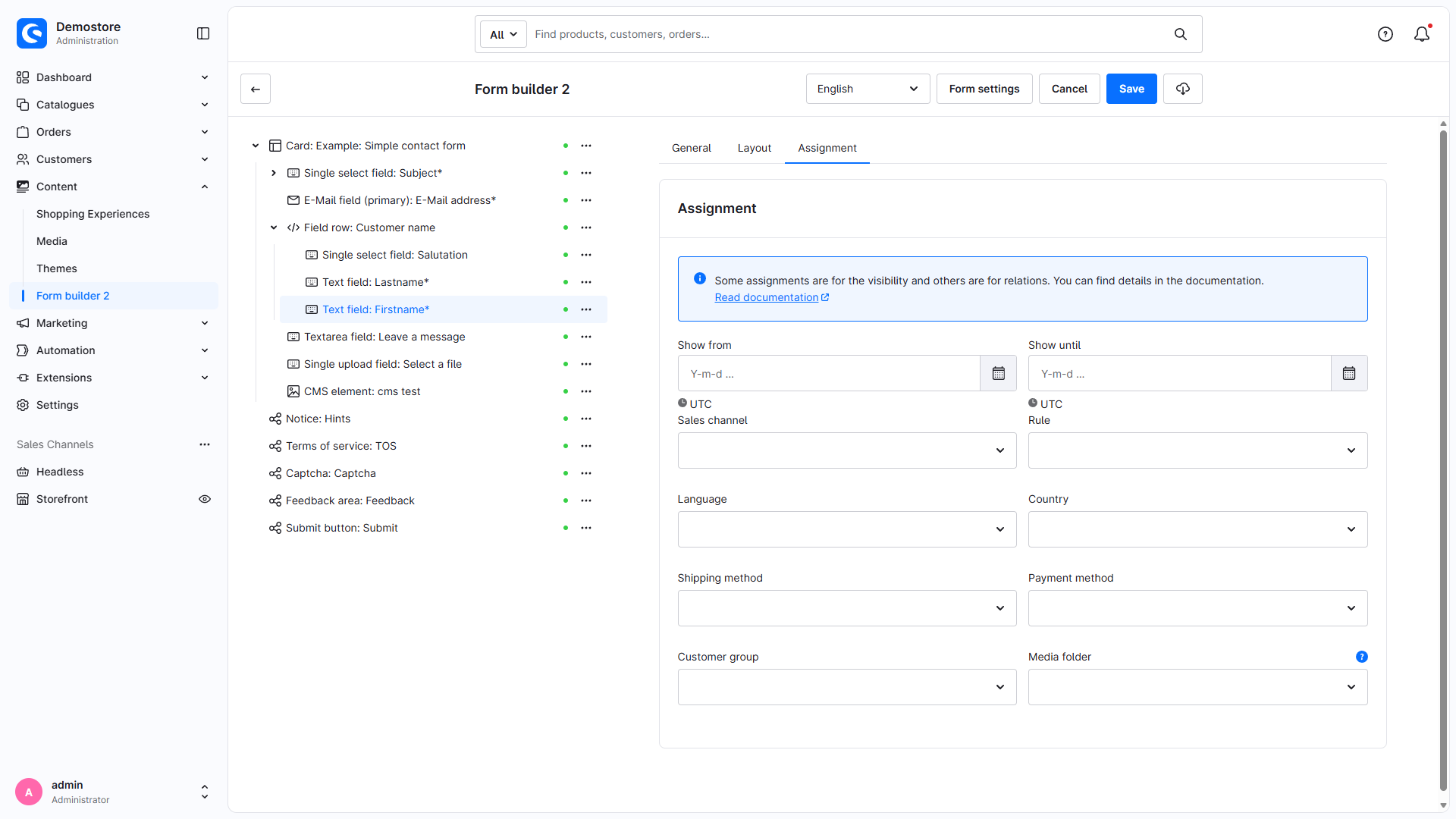
Assignments of elements and forms
You can generally configure the visibility of forms and elements here.
Show a form/element...
- show only in a certain period of time
- only display in a certain sales channel
- show only for a selected delivery country
- show only for a selected shipping method or payment method
- Display only for a selected customer group
A product-specific form...
- can be assigned to a product stream
An element of the group Sections...
- can be assigned to a background image here
Some of these assignments are only available in the Form Builder 2 Add-Ons!
Layout and stylesheet settings
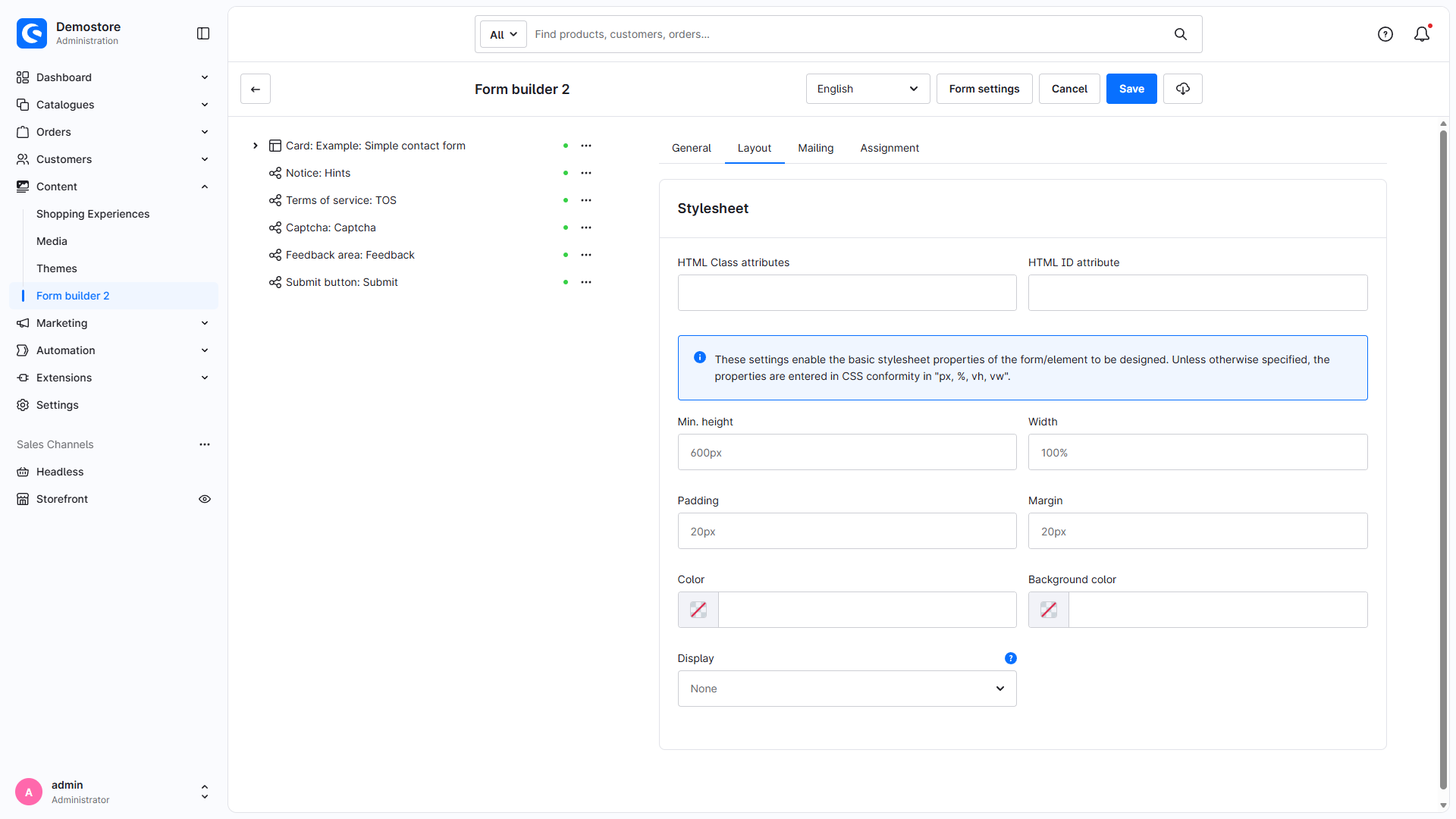
You can assign stylesheet attributes to each form/element.
The CSS options vary depending on the type of form/element.
Settings for elements
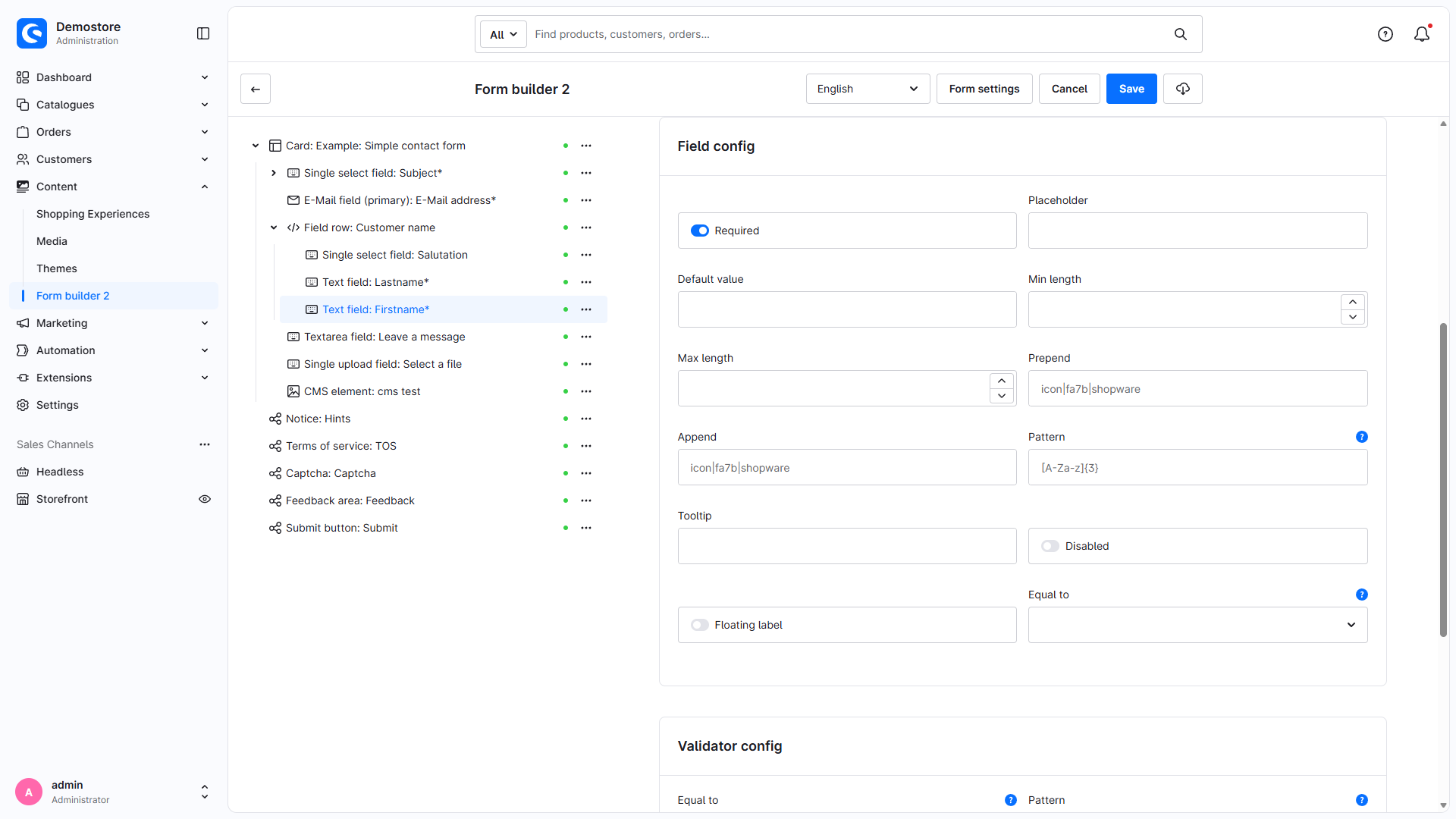
Field configuration
All elements from the Field and Multi-Field group can have additional properties in this configuration.
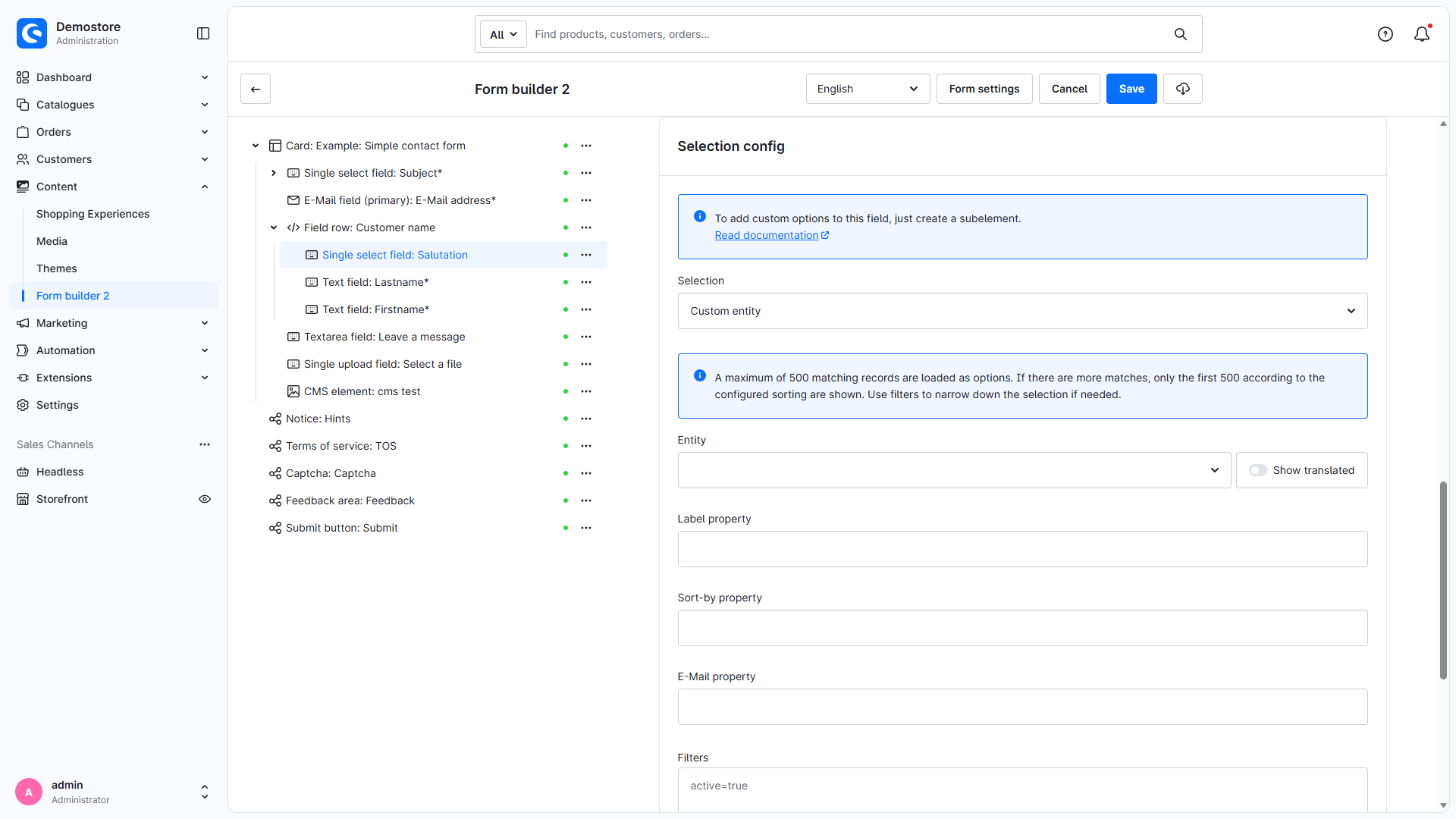
Selection Configuration
All elements from the Multi-Field group can receive database-specific values. Add-ons offer more possibilities here.
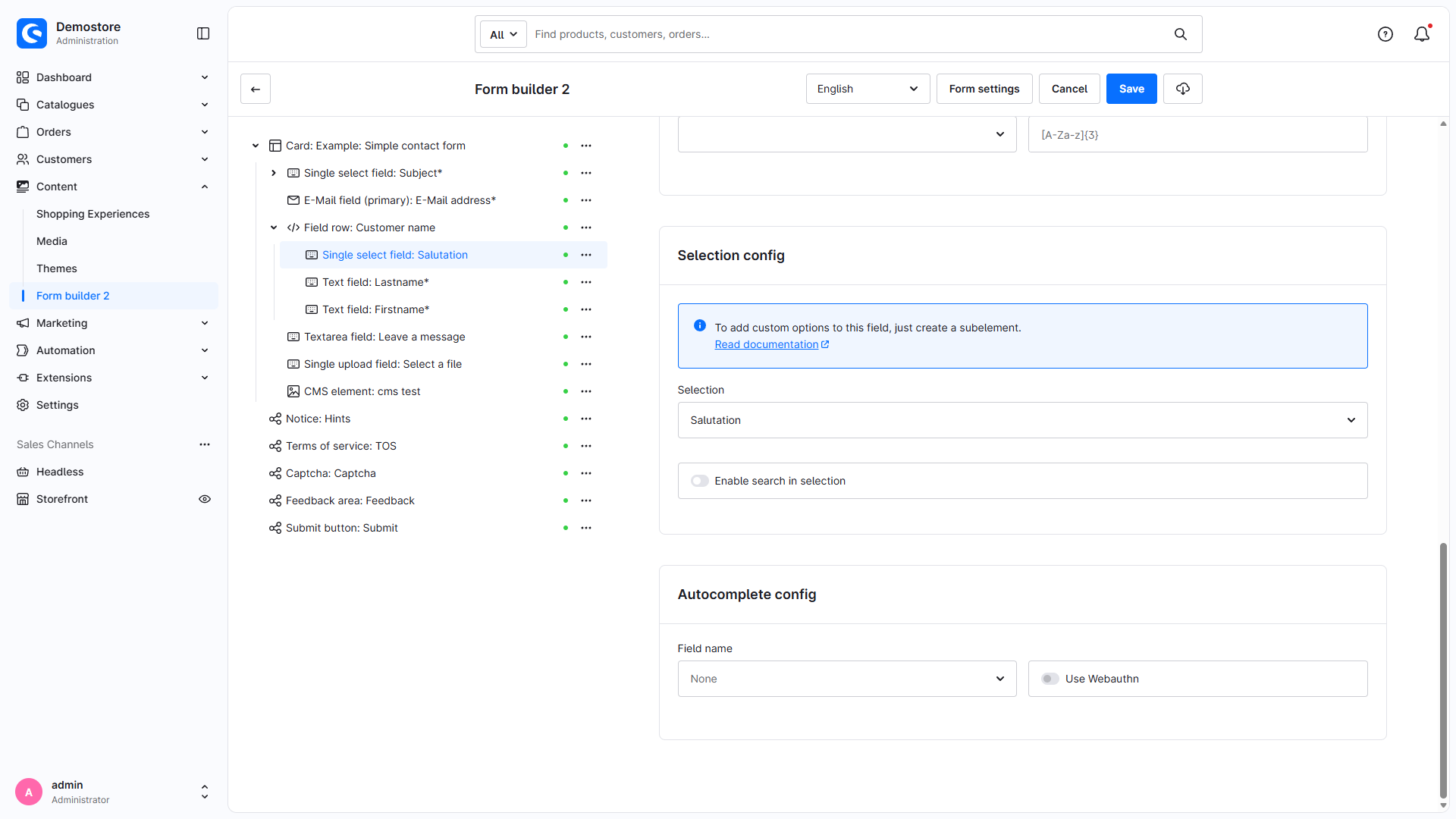
Select custom-entity to configure a DAL source, labels and filters. At most 500 options are loaded. This screenshot shows an unsaved selection.
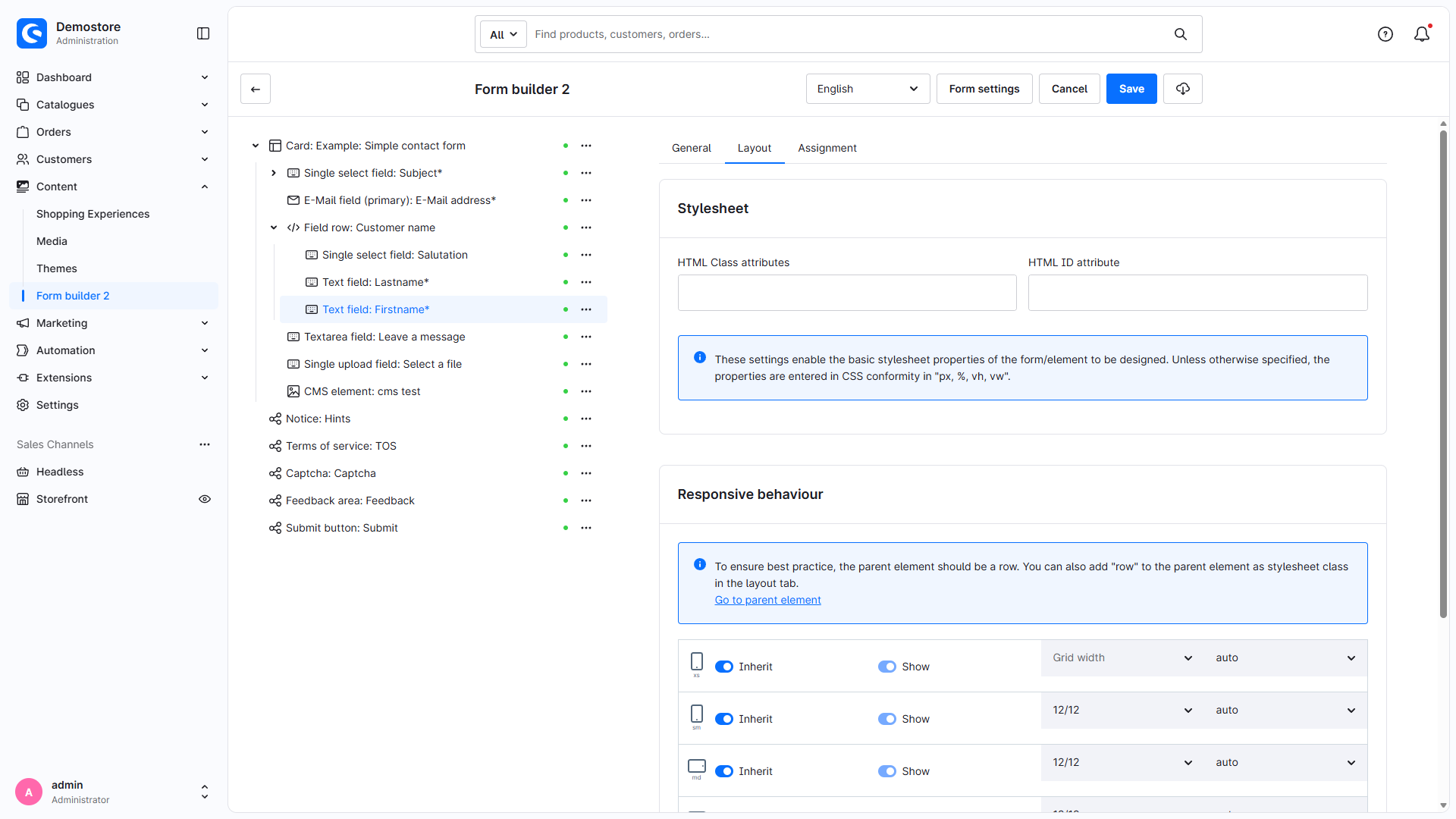
Responsive behaviour
If the parent element is from the Rows group, all elements contained in it can be given responsive properties. The rule "Mobile-First" applies here, the properties are always passed on.
The distribution is as follows.
Viewport (xs to xxl) | Inherited (Yes/No) | Display (Yes/No) | Width | Sorting/Arrangement
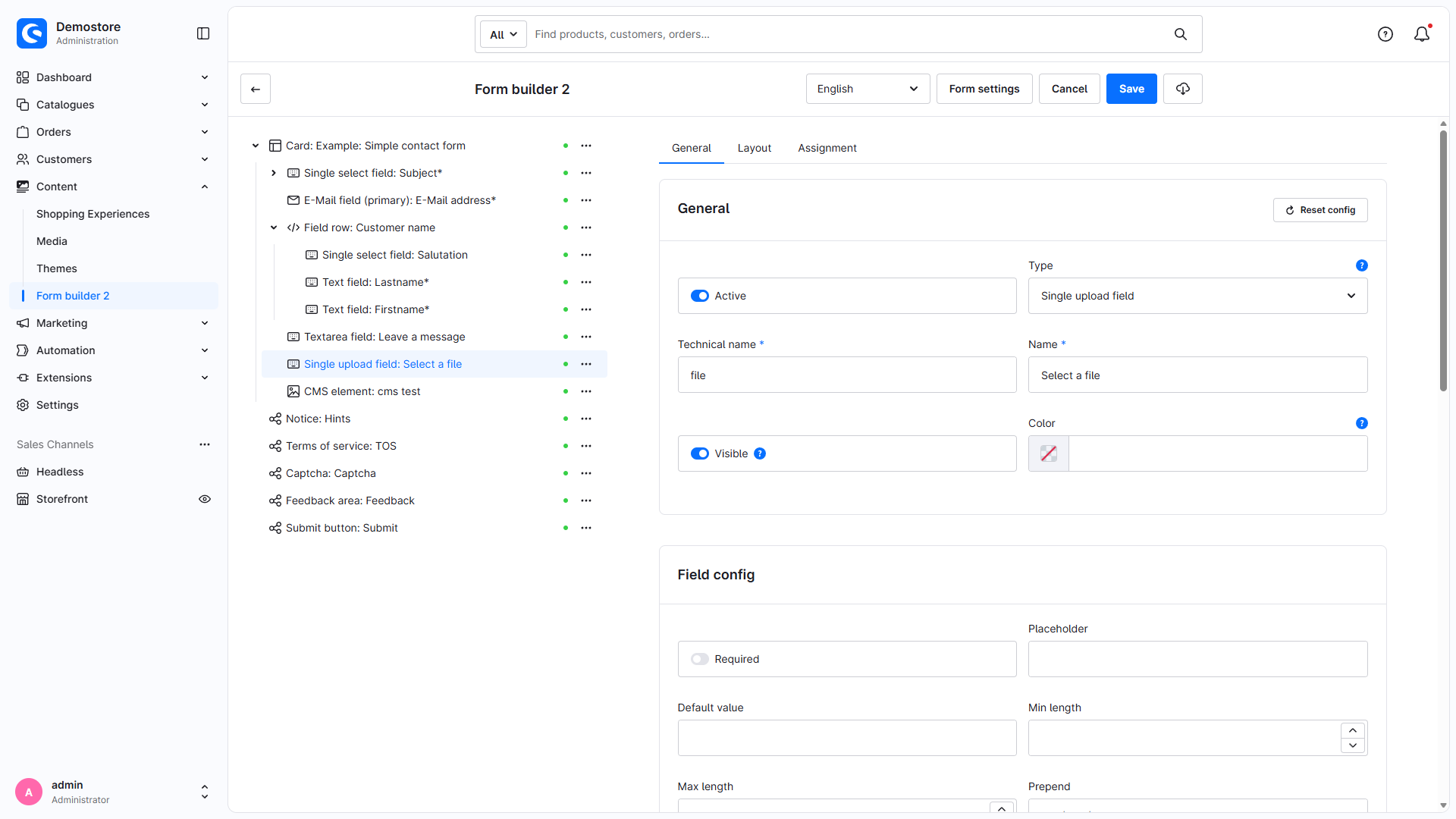
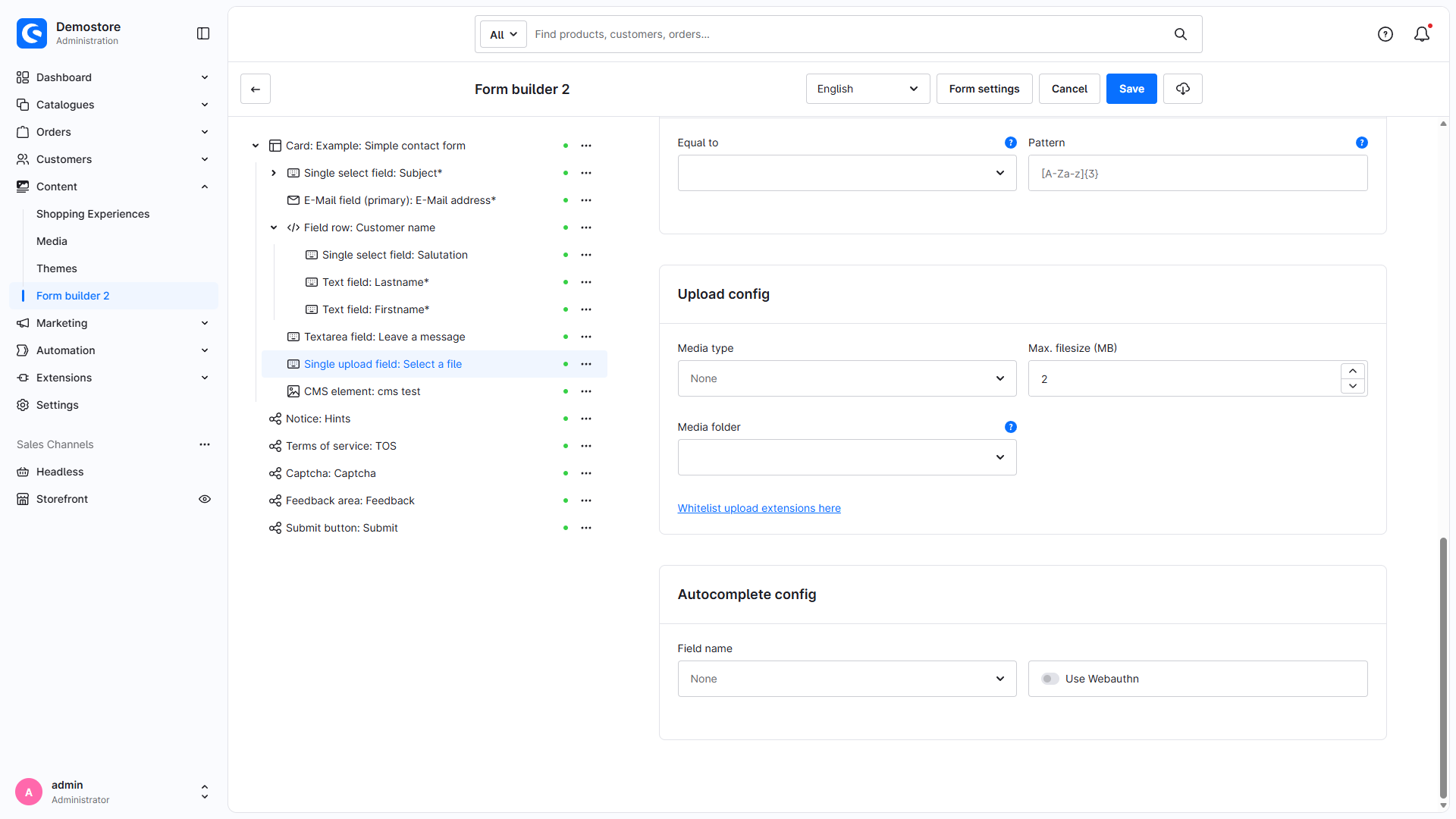
Configuration Upload Field
Date, time and number fields
Date fields provide calendar settings, weekday selection and date limits. Time and number fields have their own input settings. These browser constraints do not automatically establish equivalent server-side validation; see the feature overview.
HTML and card sections
HTML content is language-specific. Card sections group related content and can be styled through their layout settings.
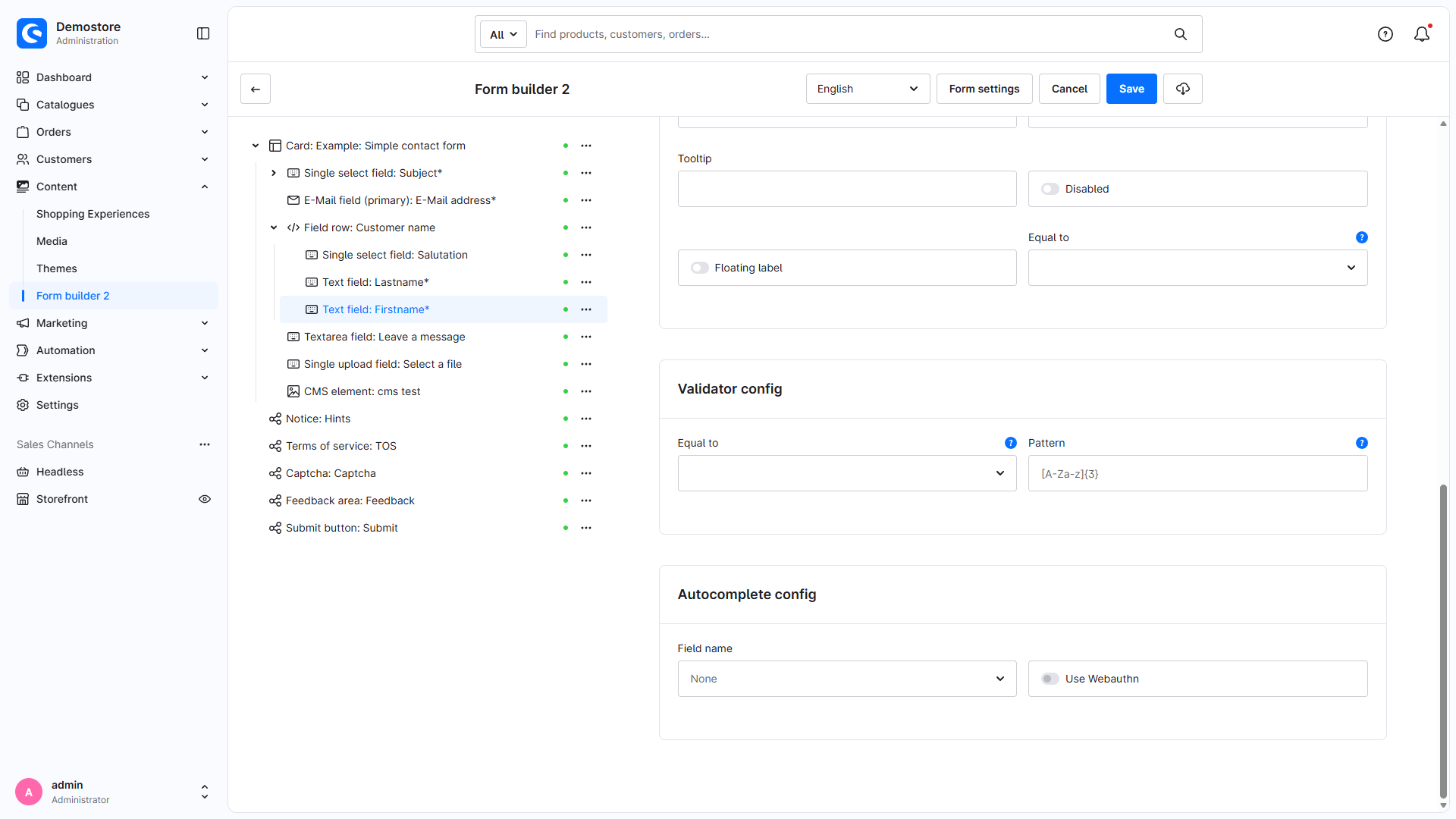
Validation
Configure required fields, lengths, patterns and comparisons on the element.
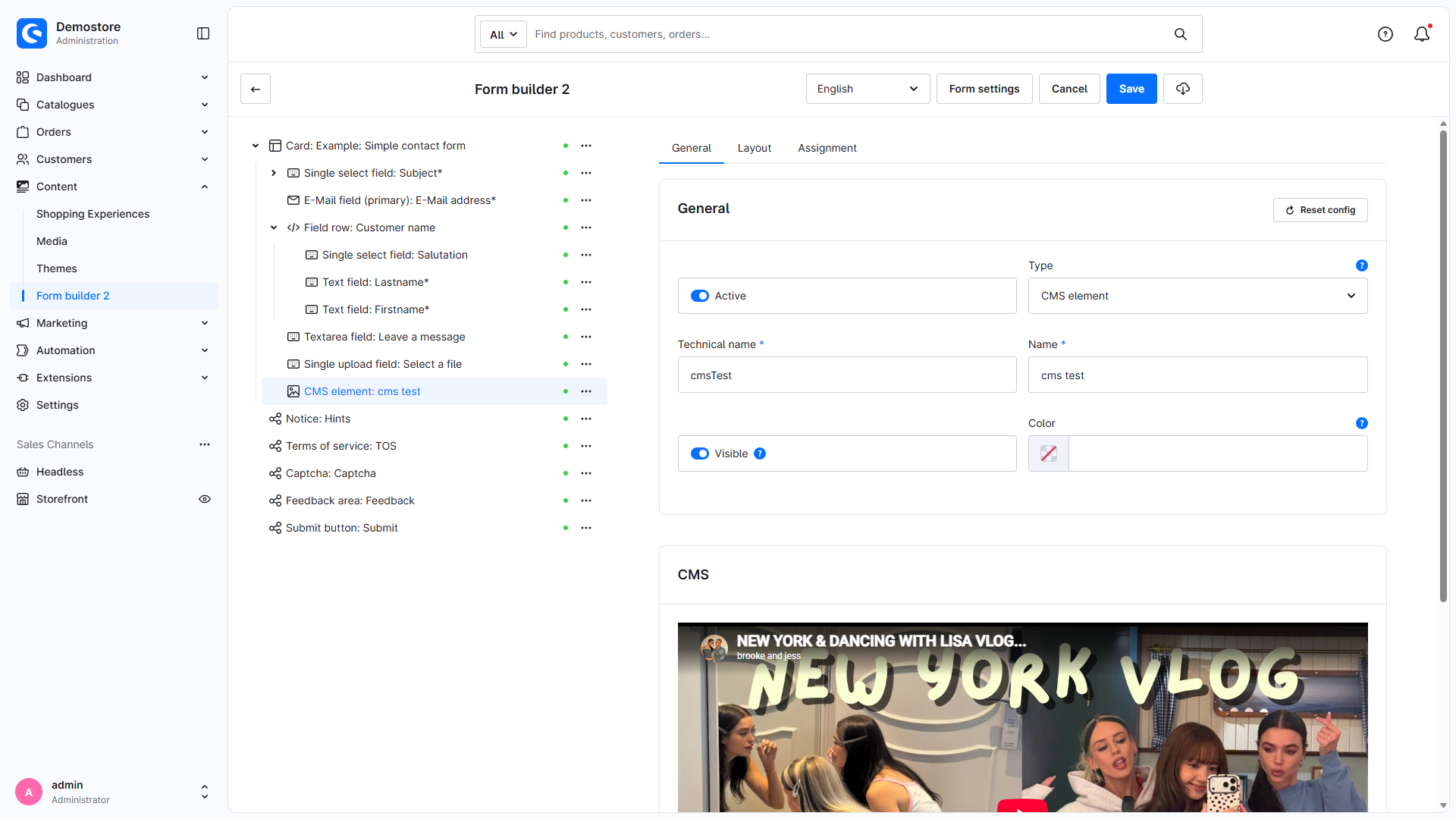
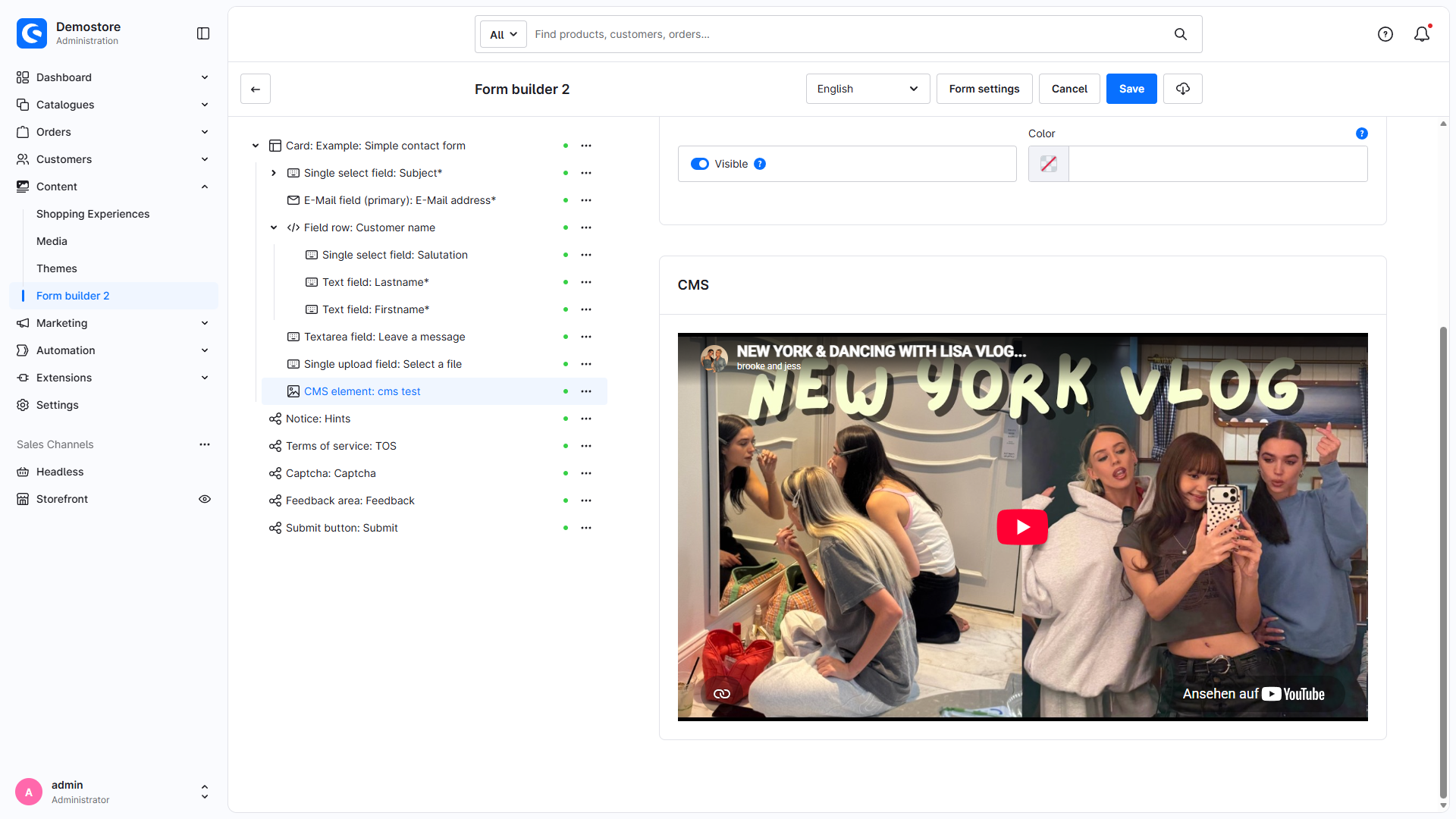
Embedded CMS elements
Add a CMS element to the form structure and configure its content.
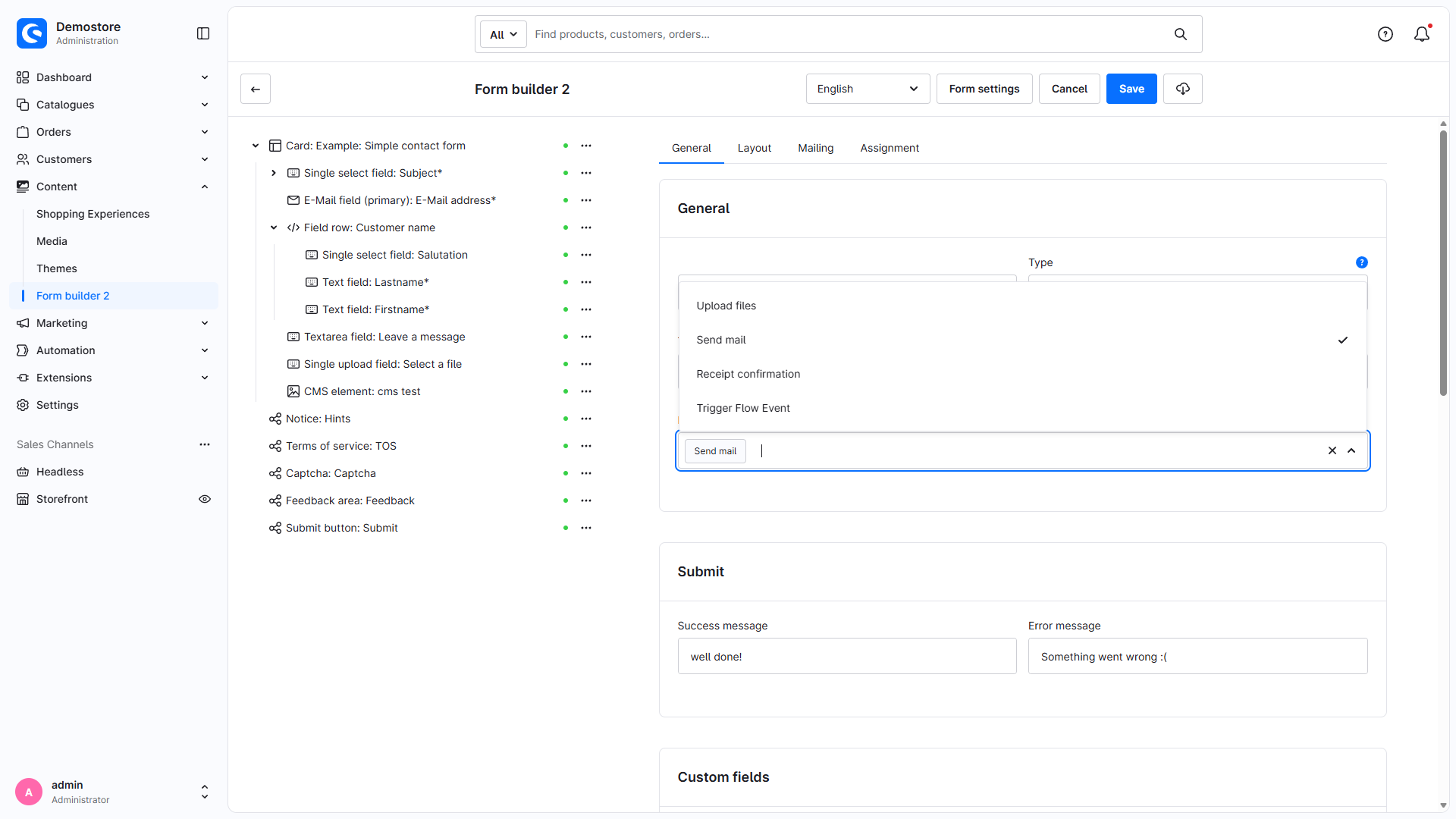
Settings for forms
Select the processing actions in the general form settings. Available actions depend on the active add-ons.
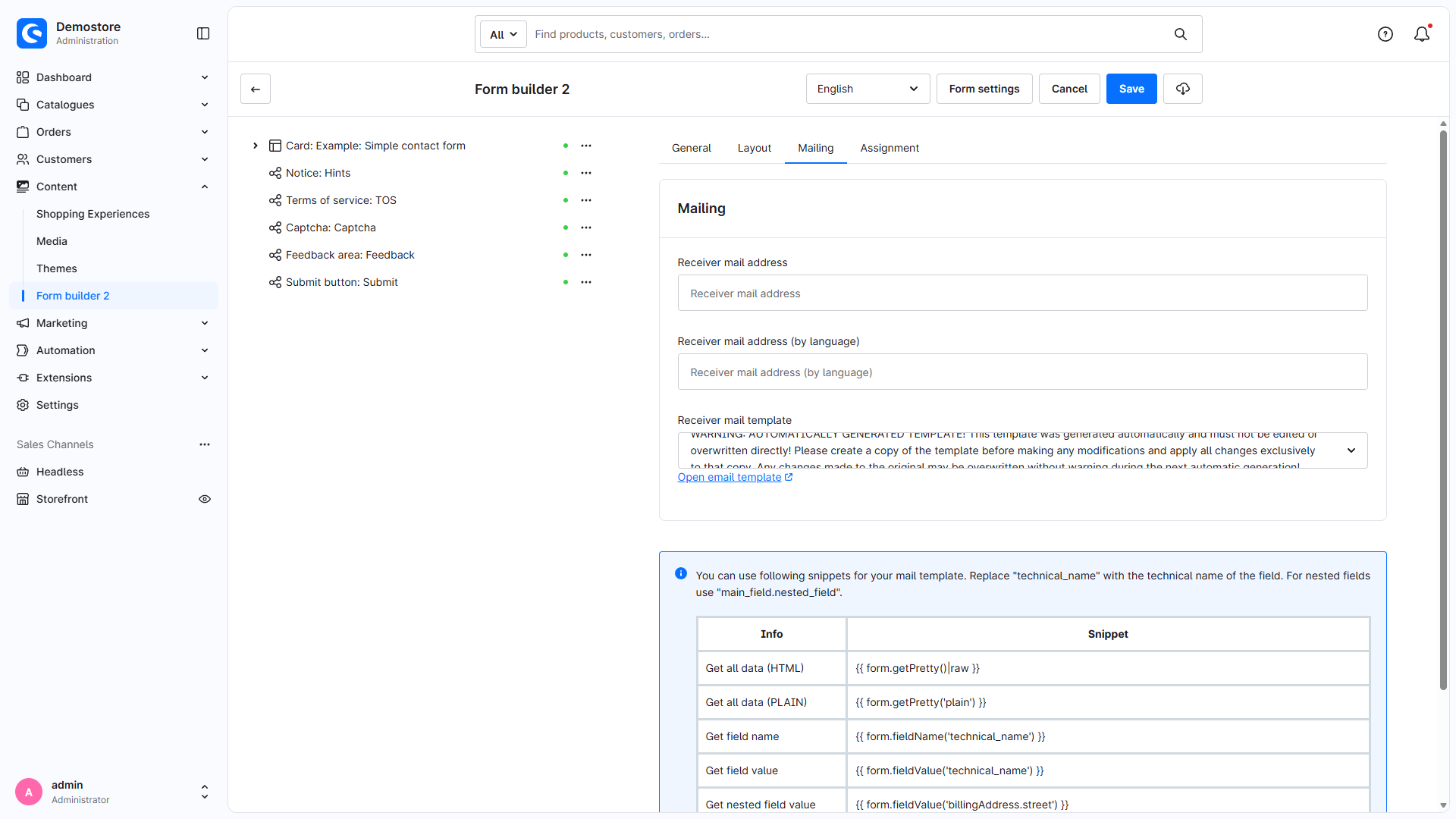
Configuration e-mail
Here you can configure the e-mail recipient. If no value is entered, the shop's standard e-mail address will be used. of the shop is used.
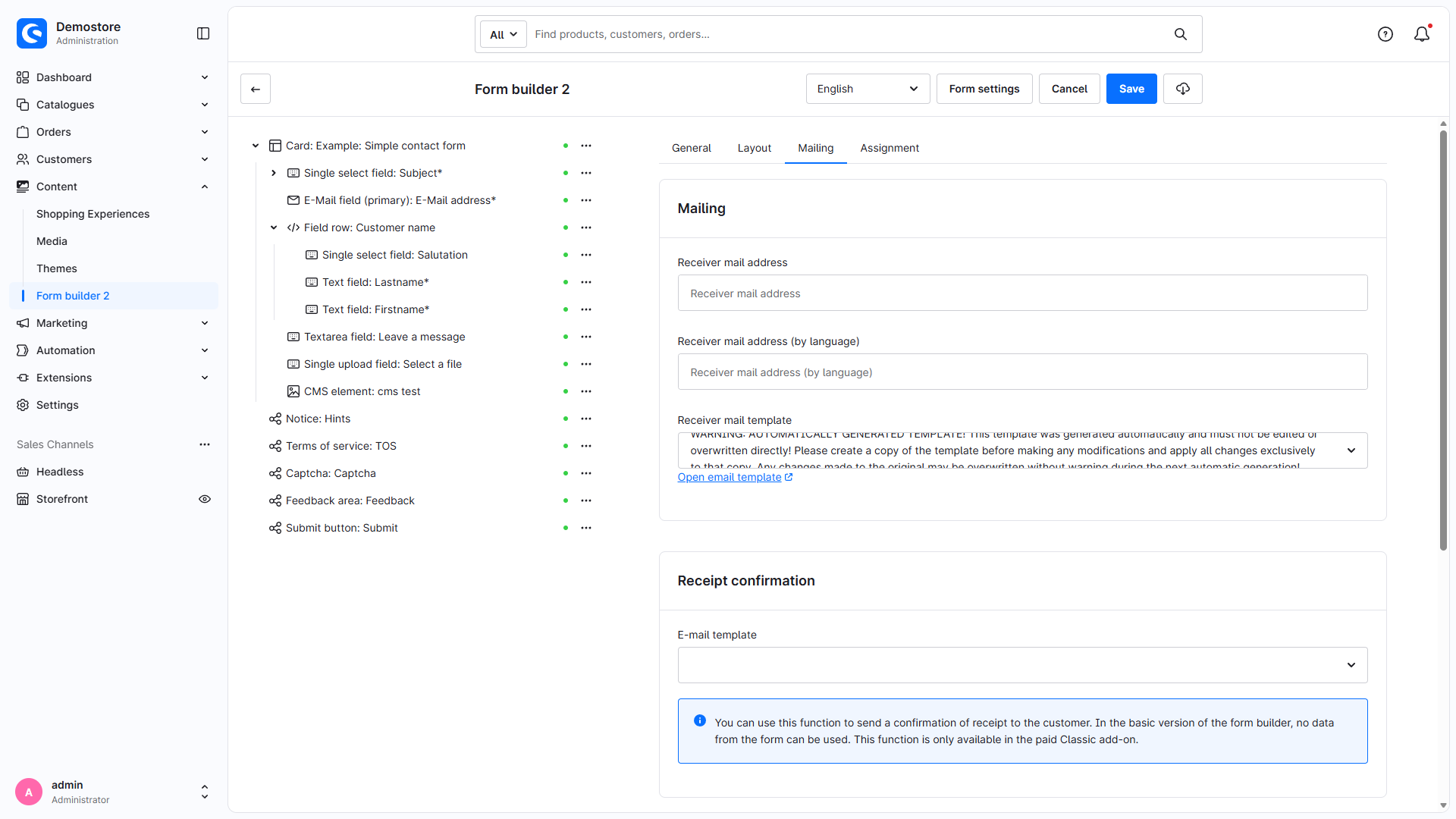
The base plugin already provides receipt-confirmation for an acknowledgement and resolves recipients from form settings, translations, suitable selected options or entity context. Classic adds a full mail copy with its own template and optional customer checkbox. An acknowledgement and a full copy are different features.
The following image shows receipt confirmation temporarily selected in the editor; this draft was not saved.
CMS settings
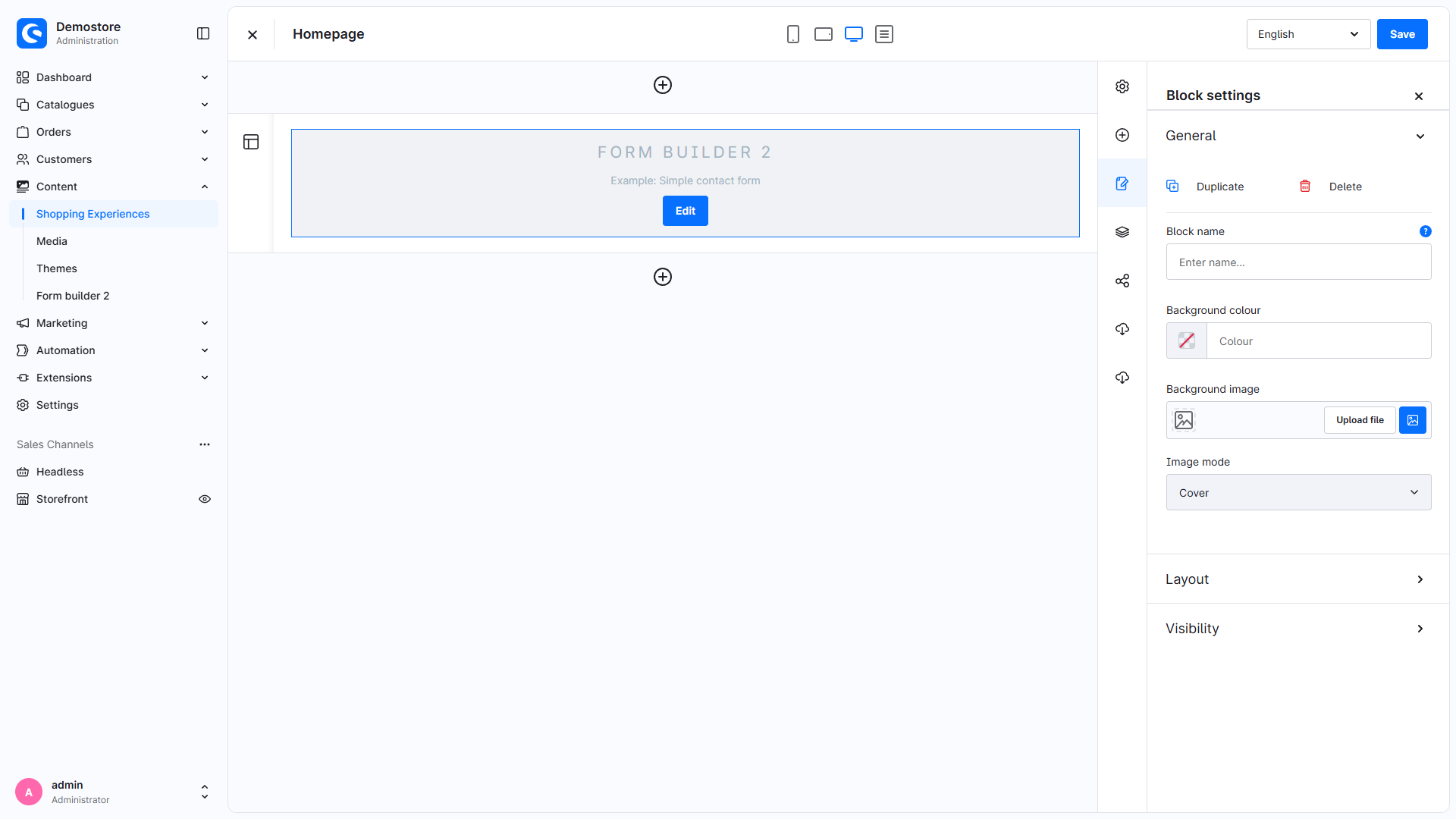
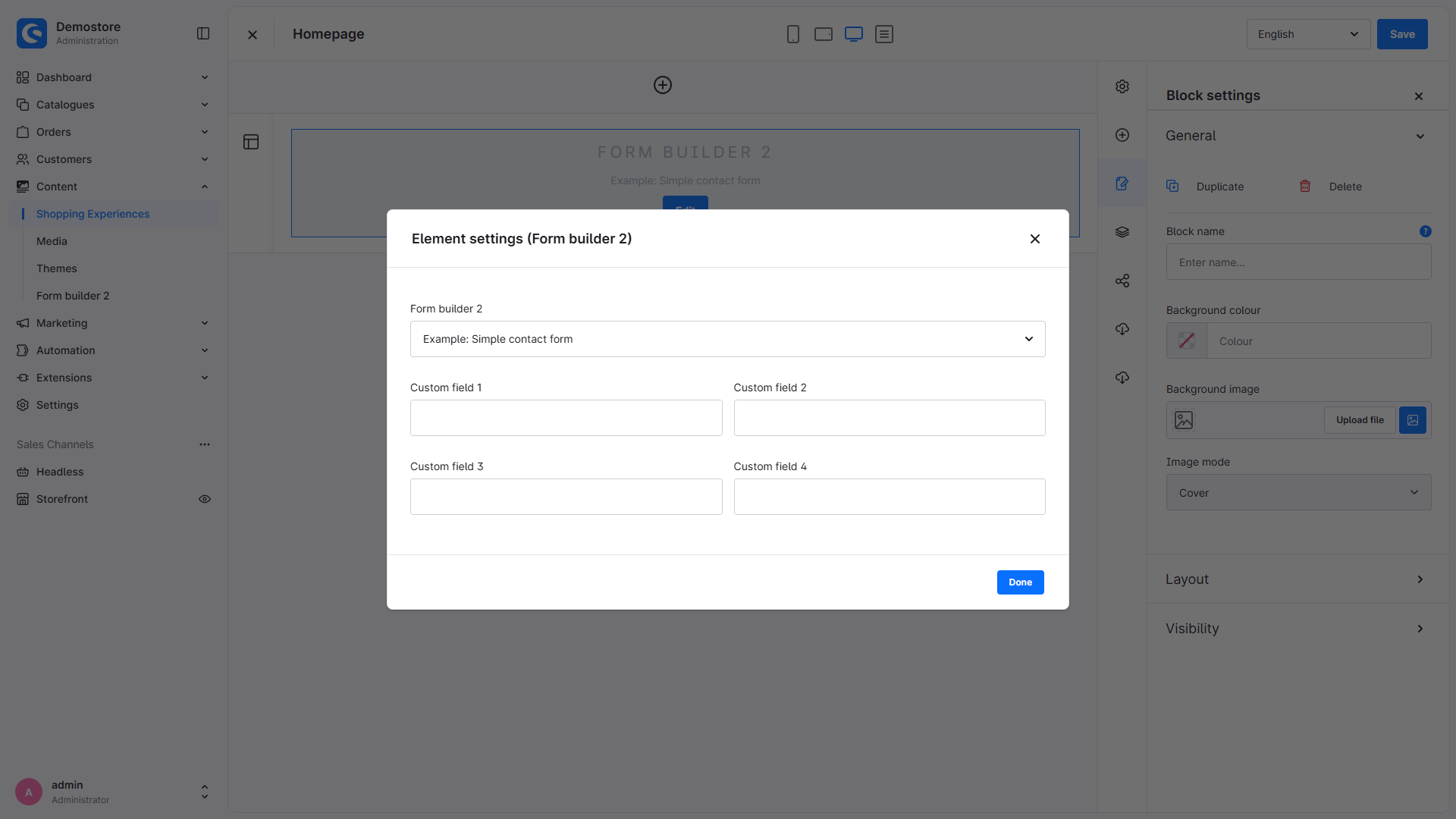
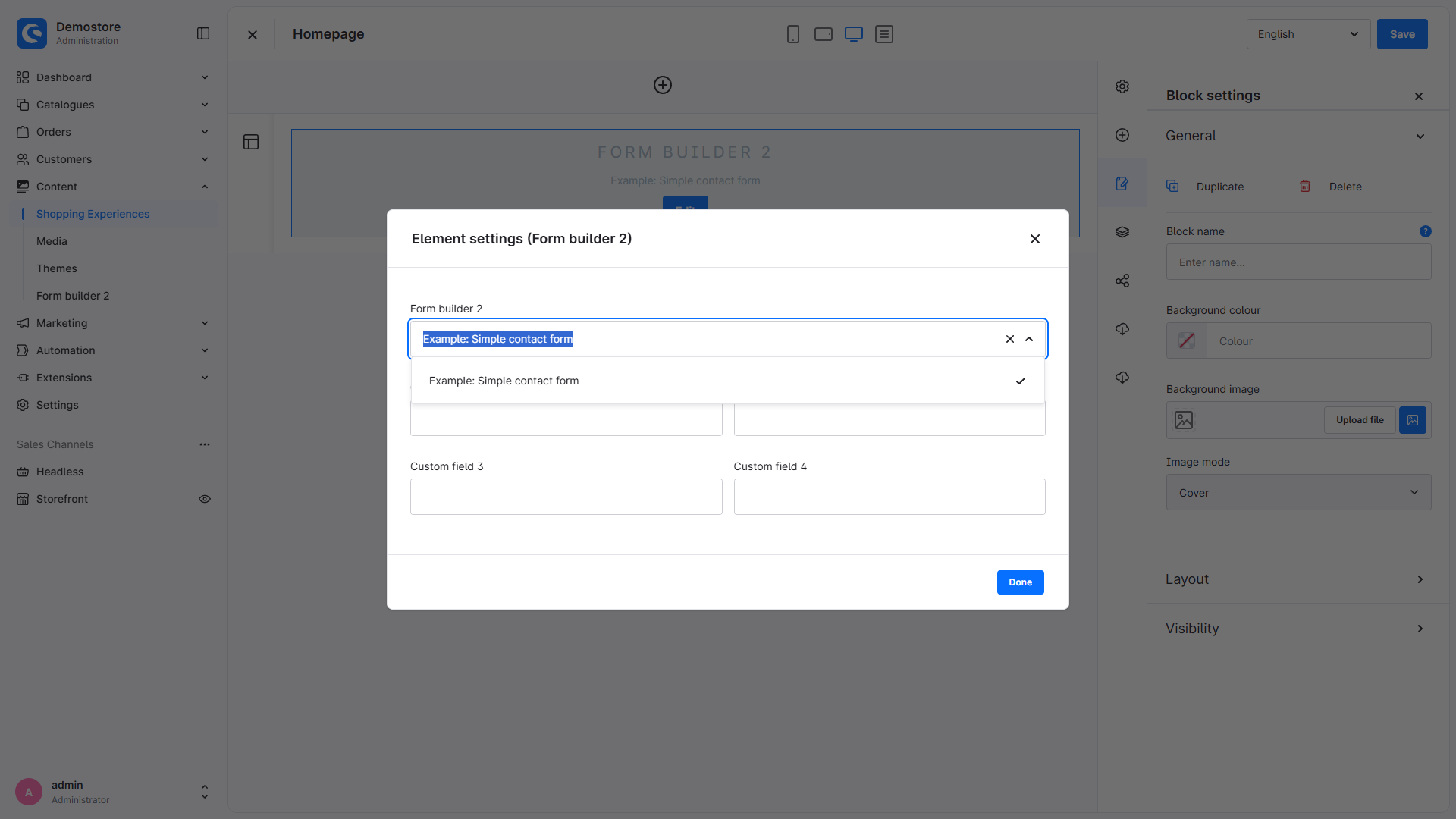
The form does not have its own block, but can be accessed via the "Replace element" icon!
After the CMS element has been inserted, you can assign forms of type CMS or Test to the CMS page.
Plugin settings
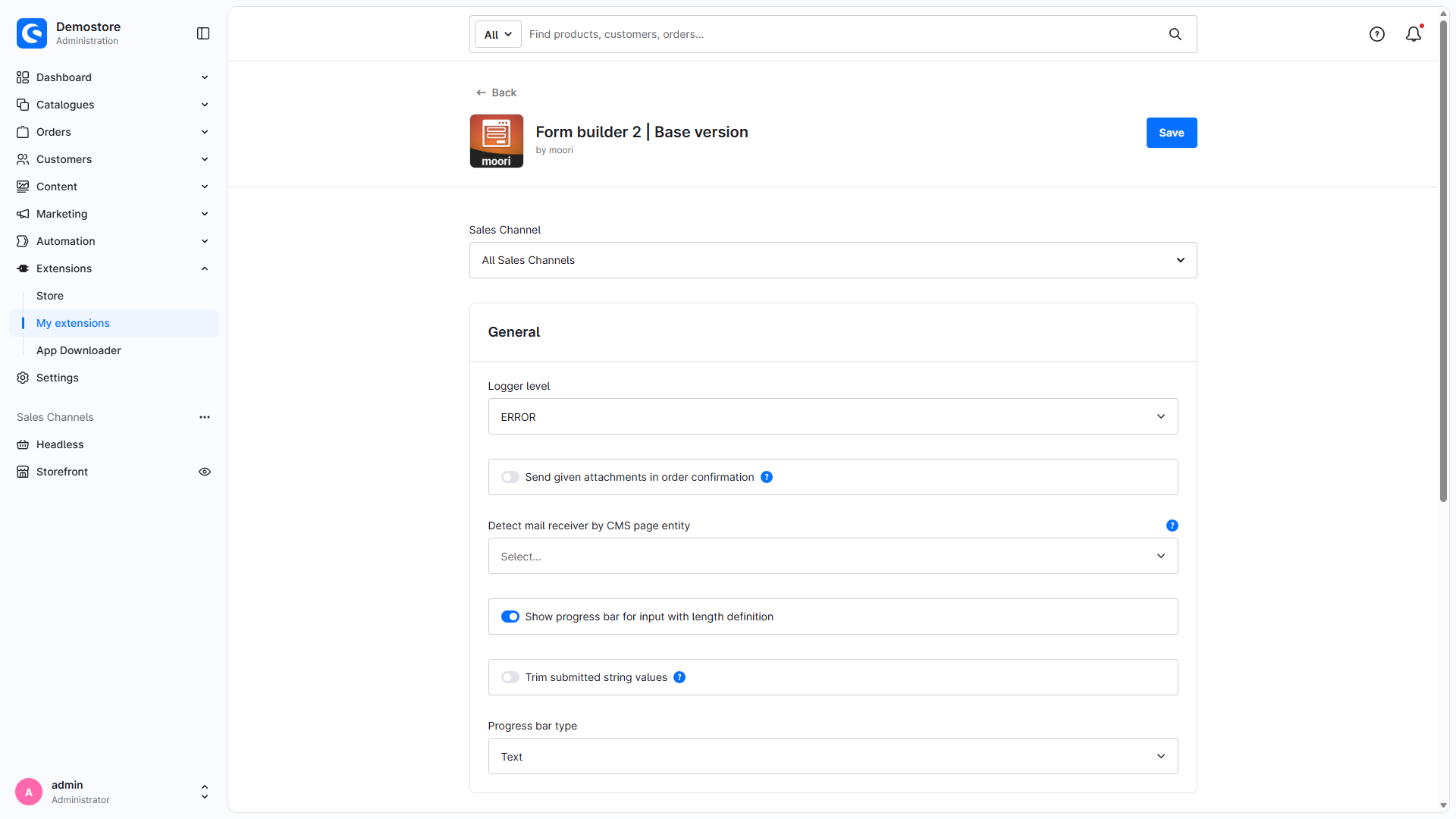
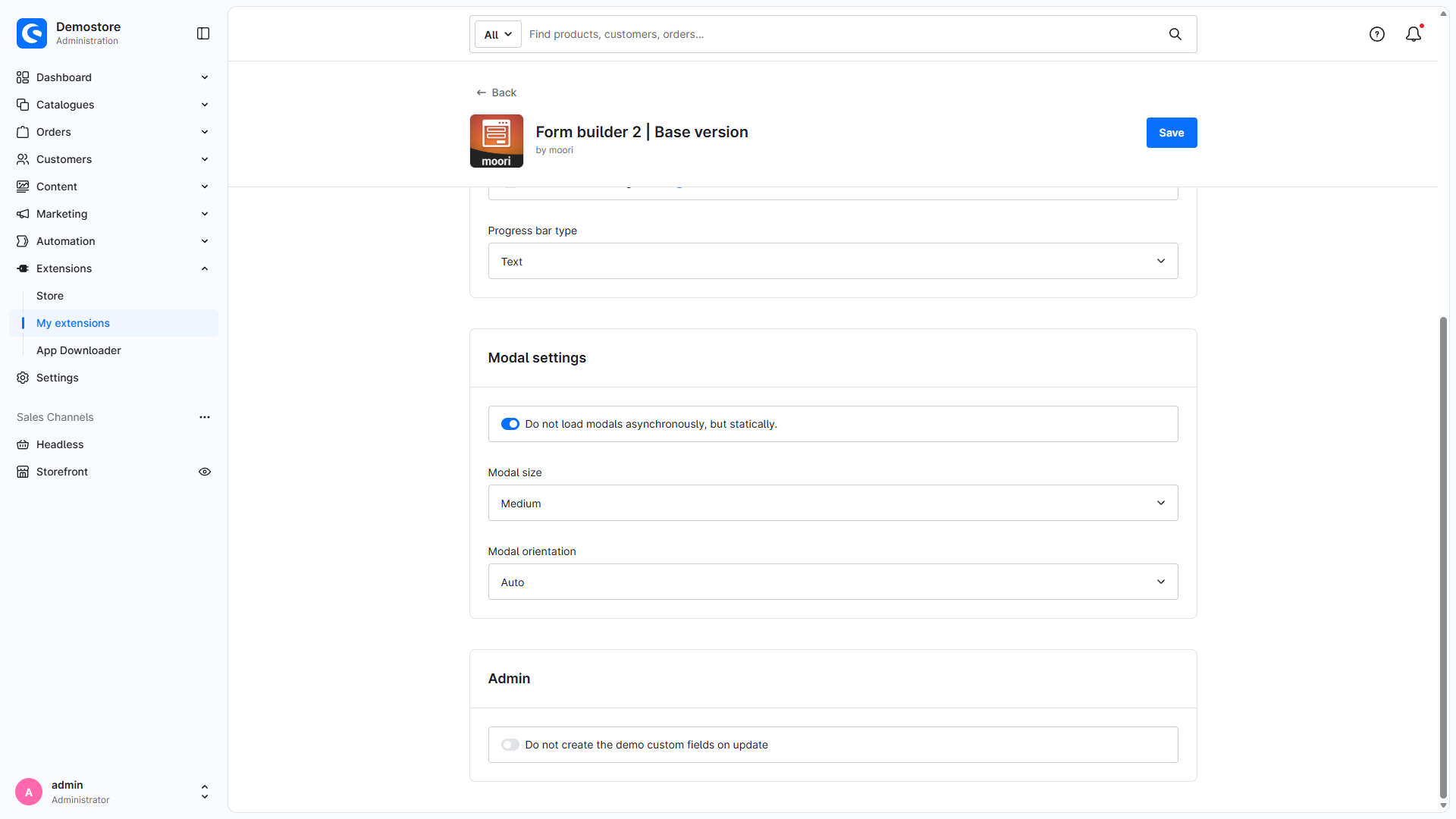
Open Extensions → My extensions → Form Builder 2 → Configure. The general settings include logging, uploads and attachments, trimming and input length indicators. Modal settings control forms opened in a modal.
Output in the storefront
Form validation
Field validation can combine browser checks with recursive server-side validation. Configure required fields, lengths, patterns and comparisons for the actual input types. Browser-only date, time, number and URL constraints have separate limits described in the feature overview.
Sending an e-mail
Enable the mail action and choose recipients and templates in the form's email settings. The email can include the formatted form summary and configured attachments. Receipt confirmation and the Classic mail copy are separate actions.
Security
- The formatted HTML summary escapes input values. Custom HTML/Twig and integrations still require configuration appropriate to their use; not every browser constraint has a corresponding server-side domain validator. See the feature overview.